There are no items in your cart
Add More
Add More
| Item Details | Price | ||
|---|---|---|---|

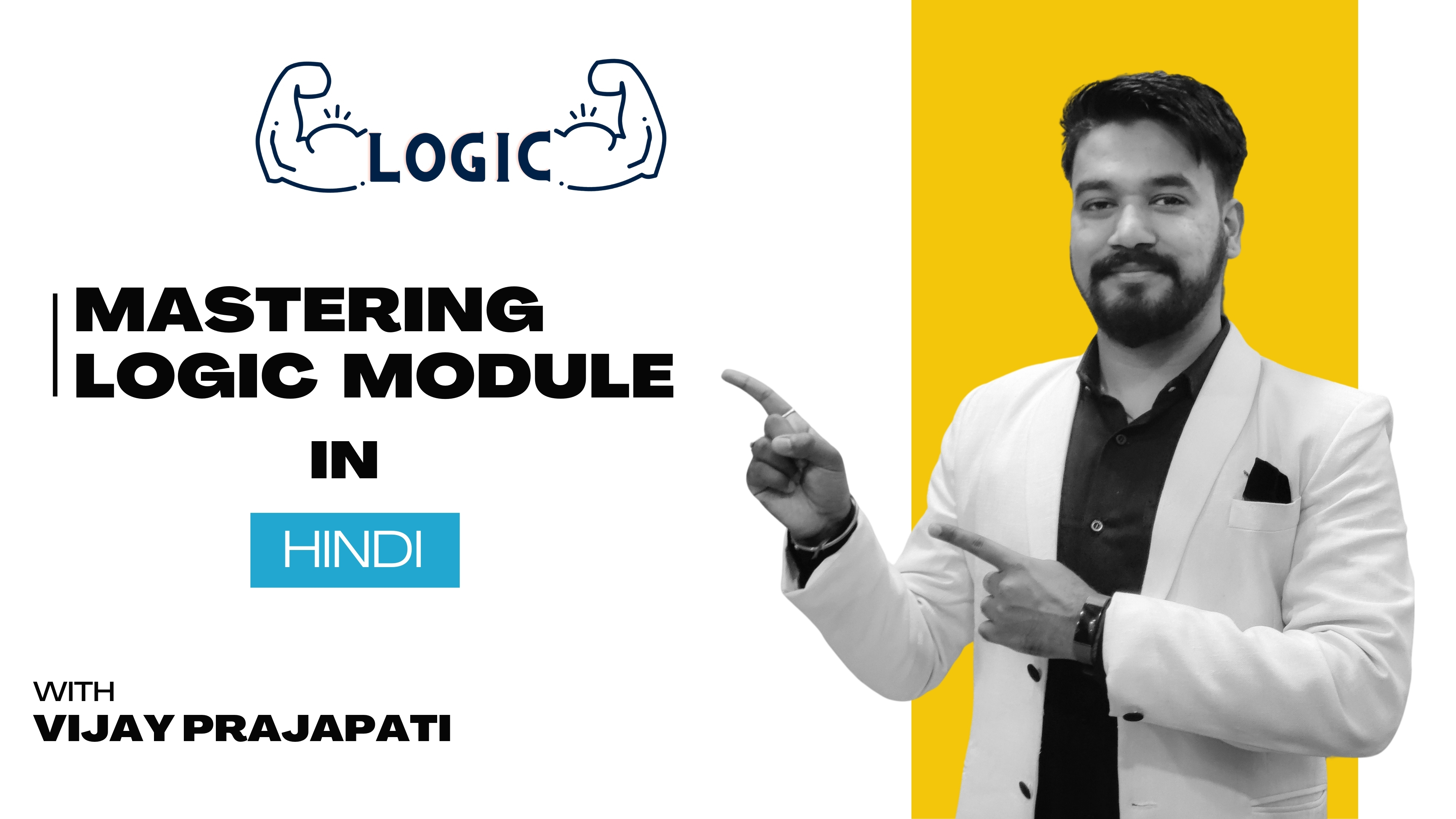
The "Mastering Logic Module" course in the IT field is an advanced training program designed to provide participants with a comprehensive understanding and practical skills in logic design and implementation.The "Mastering Logic Module" course is an in-depth exploration of the principles and applications of logic within various domains. This comprehensive course delves into both theoretical foundations and practical techniques for understanding, analyzing, and applying logical reasoning.Logic plays a foundational role in computer science and information technology, serving as the basis for console base, desktop base, web base, mobile base, data science, artificial intelligence Technologies and digital circuitry, programming, algorithmic problem-solving, and more
Throughout the course, students will develop a strong grasp of fundamental concepts such as propositional logic, predicate logic, Boolean algebra, truth tables, logical equivalence, inference rules, and proof techniques. Emphasis is placed on building proficiency in formal methods of reasoning, argumentation, problem-solving skills, critical thinking, and logical reasoning. Participants will learn how to analyze complex systems, identify logical errors, and optimize circuit designs for performance, power efficiency, and reliability.
The "Mastering Logic Module" course in the IT field is an advanced training program designed to provide participants with a comprehensive understanding and practical skills in logic design and implementation.The "Mastering Logic Module" course is an in-depth exploration of the principles and applications of logic within various domains. This comprehensive course delves into both theoretical foundations and practical techniques for understanding, analyzing, and applying logical reasoning.Logic plays a foundational role in computer science and information technology, serving as the basis for console base, desktop base, web base, mobile base, data science, artificial intelligence Technologies and digital circuitry, programming, algorithmic problem-solving, and more
Throughout the course, students will develop a strong grasp of fundamental concepts such as propositional logic, predicate logic, Boolean algebra, truth tables, logical equivalence, inference rules, and proof techniques. Emphasis is placed on building proficiency in formal methods of reasoning, argumentation, problem-solving skills, critical thinking, and logical reasoning. Participants will learn how to analyze complex systems, identify logical errors, and optimize circuit designs for performance, power efficiency, and reliability.
Key topics covered in the course include:
1. Propositional Logic: Understanding the syntax and semantics of propositional logic, including propositions, logical operators (AND, OR, NOT), truth tables, and logical equivalences.
2. Predicate Logic: Extending propositional logic to predicate logic, including quantifiers (universal and existential), predicates, and quantified statements.
3. Inference Rules: Learning deductive inference rules such as modus ponens, modus tollens, hypothetical syllogism, and proof by contradiction.
4. Logical Equivalence and Normal Forms: Exploring techniques for establishing logical equivalence, simplifying logical expressions, and converting logical expressions to standard forms such as conjunctive normal form (CNF) and disjunctive normal form (DNF).
5. Formal Proofs: Developing skills in constructing formal proofs using various proof techniques such as direct proof, indirect proof (proof by contradiction), mathematical induction, and proof by cases.
6. Applications of Logic: Applying logical reasoning to diverse areas such as computer science, mathematics, philosophy, linguistics, and artificial intelligence.
The course employs a combination of theoretical lectures, hands-on exercises, problem-solving sessions, and real-world case studies to reinforce understanding and practical application. Students will also have opportunities to engage in collaborative projects and discussions to deepen their comprehension and critical thinking skills.
By the end of the "Mastering Logic Module" course, participants will emerge with a comprehensive understanding of logic and its applications, equipped with the analytical tools and reasoning strategies necessary to tackle complex problems across various disciplines. Whether pursuing further studies in mathematics, computer science, philosophy, or any field requiring logical reasoning, students will find this course to be an invaluable foundation for their academic and professional endeavors."Mastering Logic Module" course will be well-equipped to tackle complex challenges and contribute effectively to the advancement of technology in various domains of IT.
HN Techno places a strong emphasis on helping students strengthen their reason and intellect because the main Mantra of HnTechno is "FRAMEWORK IS TEMPORARY BUT LOGIC IS PERMANENT".
 Launch your Graphy





.png)